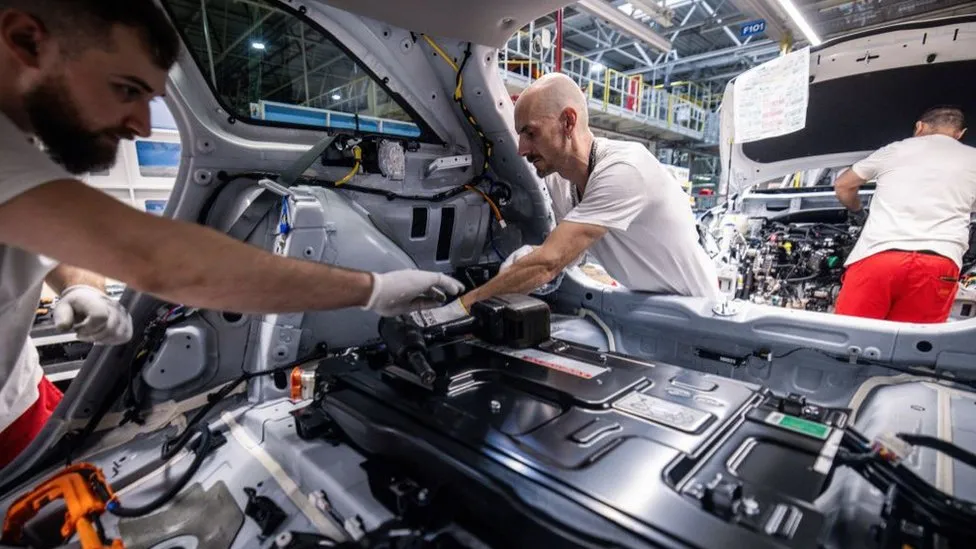
The Biden administration issued new rules to prevent Chinese firms from supplying parts for electric cars set to receive billions of dollars in tax credits.
The Biden administration proposed new rules on Friday aimed at shifting more production of electric vehicle batteries and the materials that power them to the United States, in an attempt to build up a strategic industry now dominated by China.
The rules are meant to limit the role that firms in China can play in supplying materials for electric vehicles that qualify for federal tax credits. They will also discourage companies that seek federal funding to build battery factories in the United States from sourcing materials from China or Russia.
The rules could encourage shifts in automotive supply chains, which continue to rely heavily on China for materials and components of electric vehicles. Automakers are also facing intense cost pressures as they try to modify their factories to make electric cars, and China offers some of the most advanced and lowest-priced battery technology in the world.
The Biden administration is trying to use billions of dollars in new federal funding to change that dynamic and create a U.S. supply chain for electric vehicles.
The climate law that President Biden signed in 2022 includes up to $7,500 in tax credits to consumers who buy electric vehicles made in the United States using largely domestic materials. The law also included a general ban on Chinese products. Lawmakers mandated that firms in China, Russia, North Korea and Iran be prohibited from providing certain materials to cars that received those tax breaks.
But the law left open several questions, including what constitutes a Chinese or Russian company. Administration officials said those definitions included any entity that was incorporated or had headquarters in China or Russia, as well as any firm in which 25 percent of the board seats or equity interest was held by Chinese or Russian governments.
Chinese companies that set up operations outside China appear to be able to benefit from the rules as long as the Chinese government is not a significant shareholder. That provision came as a relief to some automakers, which feared that the Biden administration might bar them from contracting with Chinese-owned mines or factories in the United States or other parts of the world.
The law also requires battery makers that strike contracts or licensing agreements with Chinese firms to ensure that they are retaining certain rights over their projects. That provision is intended to make sure a Chinese firm is not effectively in control of such a project.
Some conservative lawmakers had challenged Ford Motor’s plans to license technology from the Chinese battery giant known as CATL for a plant in Marshall, Mich., arguing that such a partnership should not be eligible for federal tax credits.
Some Republican lawmakers suggested on Friday that the Treasury Department’s guidance did not go far enough to lessen the country’s dependence on China.
“At a time when China is using massive subsidies to undercut U.S. manufacturers and throttle the global market for battery components, Treasury’s naïve new regulations would open the floodgates for American tax dollars to flow to Chinese companies complicit in trade violations and forced labor abuses,” said Representative Mike Gallagher of Wisconsin, chairman of the House Select Committee on the Chinese Communist Party.
The rules kick in for battery components in 2024, and in 2025 for critical minerals like lithium, cobalt and nickel. They could be adjusted depending on industry comment.
The rules could have a profound impact on the U.S. electric vehicle market, which is rapidly growing — battery-powered vehicles made up about 8 percent of new cars sold in the third quarter. Car and battery makers said Friday that they were still reviewing the rules, and that it would take time to determine how many models would qualify for tax credits.
Tesla said on Friday that the two least expensive versions of its Model 3 sedan would qualify for only half the $7,500 credit starting in January. The Model Y sport utility vehicle also might not qualify for the full credit after Dec. 31, Tesla said. The Model Y and Model 3 are the top two electric vehicles by sales in the United States. Tesla buys some batteries from CATL.
John Bozzella, the chief executive of Alliance for Automotive Innovation, wrote in a blog post Friday that the rules struck “a pragmatic balance,” including by exempting trace materials. If the administration had banned all minor Chinese parts from the supply chain, no car models might have qualified for tax credits next year, he said.
Many cars have already been disqualified from purchase credits by other rules, like a requirement that vehicles be assembled in North America. Only about 20 vehicles currently qualify for the program out of more than 100 electric vehicles sold in the United States.
The rules also raised new questions about whether stricter requirements for supply chains could continue a trend of driving more shoppers to lease, rather than buy, vehicles.
The prohibition on sourcing from China applies only to vehicles that are sold, not to those that are leased. Consumers can receive tax credits for electric vehicles they lease from auto dealers, and that has led to a boom in E.V. leasing.
Jack Fitzgerald, chairman of Fitzgerald Auto Malls, which operates dealerships in Florida, Maryland and Pennsylvania, said he had seen a spike in customers leasing electric vehicles. But he said concern about electric vehicle range and the availability of chargers, more than price, was holding back electric vehicle sales.
“That’s the principal thing,” Mr. Fitzgerald said.
Auto industry lobbyists have warned that extremely strict rules could stifle electric vehicle sales, and they have urged the administration to strike more trade deals to secure supplies of scarce battery minerals. But Paul Jacobson, the chief financial officer of General Motors, said the company had structured its electric vehicle operations to be successful regardless of the federal rules.
“We’re not anchoring the business on saying this has to happen” with regard to regulations, Mr. Jacobson told reporters on Thursday. If regulations change, he added, “it’s not a backbreaking thing for us.”
While the rules may create headaches for automakers, they are likely to benefit companies planning to supply batteries from factories in the United States.
“It’s actually good news for us,” said Siyu Huang, chief executive of Factorial, a Massachusetts company that is developing next-generation electric vehicle batteries with support from Mercedes-Benz, Hyundai and Stellantis, the owner of Dodge, Jeep and Ram.
Acquiring large amounts of lithium, an essential ingredient in batteries, could be difficult because most of the metal is processed in China, Ms. Huang said. But the rules will encourage investment in U.S.-based refineries, she continued. “Its definitely going to be another incentive to build more domestic supply,” Ms. Huang said.
John DeMaio, chief executive of Graphex Technologies, which is building a factory in Michigan to process graphite for batteries, said the rules might temporarily slow electric vehicle sales by making it harder to qualify for the tax credit. But in the long run, he added, they will encourage investment in domestic suppliers.
“It might be a hiccup,” he said, “but in general it provides certainty and clarity to get people off the fence.”
Wally Adeyemo, the deputy secretary of the Treasury Department, said in a briefing with reporters that the rules would help advance the administration’s goals of building up an American clean energy supply chain while also cutting emissions in the transportation sector.
“These changes take time, but companies are making the investments and Americans are buying these cars,” he said.
Over the past year, companies have invested $213 billion in the manufacturing and deployment of clean energy, clean vehicles, building electrification and carbon management technology in the United States, according to tracking by the Rhodium Group and the Center for Energy and Environmental Policy Research at the Massachusetts Institute of Technology. That is a 37 percent increase from a year earlier.
.
Still, the global electric vehicle industry remains heavily anchored in China, which is the world’s largest producer and exporter of electric vehicles. China produces about two-thirds of the world’s battery cells, and refines most of the minerals that are key to powering an electric vehicle.
The rules also restrict automakers from sourcing nickel used in their batteries from Russia, which is one of the world’s largest nickel producers.
One of the challenges for automakers will be developing systems to track all the components of their battery through a long, and often opaque, supply chain.
Vehicles that are reported incorrectly will be subtracted from an automaker’s eligibility for tax credits, Treasury said, and automakers that commit fraud or intentionally disregard the rules could be declared ineligible for the credit in the future.
"electric" - Google News
December 01, 2023 at 08:45PM
https://ift.tt/nNXZeMa
U.S. Limits China's Ability to Benefit From Electric Vehicle Subsidies - The New York Times
"electric" - Google News
https://ift.tt/Z5IHwi7
https://ift.tt/N2HO1Yn