Rechercher dans ce blog

Thursday, July 1, 2021

Nissan to make new electric cars, batteries in Britain - ABC News

mivo.indah.link

Japanese carmaker Nissan and two partners have announced plans to invest 1 billion ($1.4 billion) pounds to produce a new model of an all-electric vehicle, and batteries, in northeast England

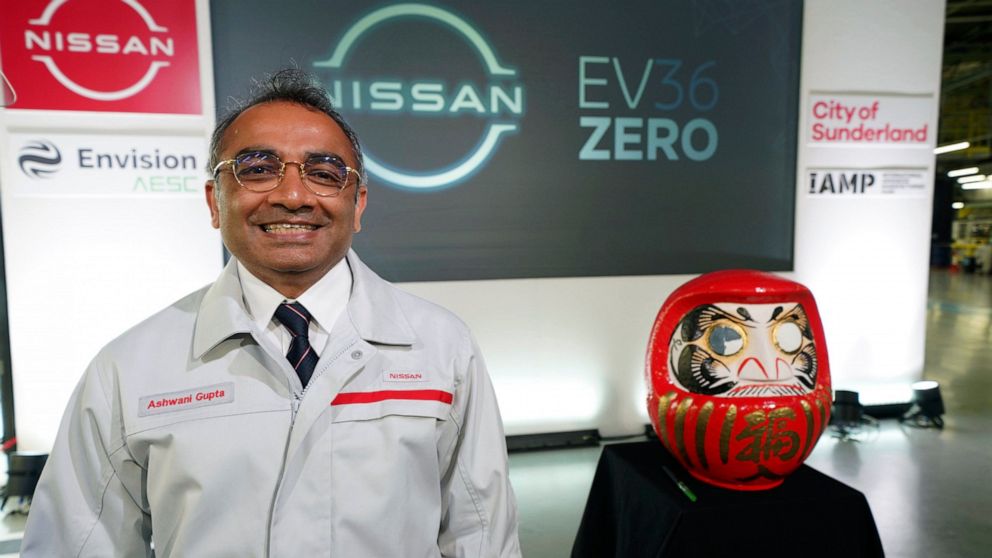
LONDON -- Japanese carmaker Nissan and its partners plan to invest 1 billion ($1.4 billion) pounds to expand production of electric vehicles and batteries in northeast England, a major victory for the U.K. government’s efforts to attract jobs and investment following the country’s departure from the European Union.

Nissan said Thursday it will build a new all-electric crossover sport utility vehicle at the company’s plant in Sunderland, creating more than 6,200 jobs at the factory and its suppliers. As part of the project, Envision AESC will build the U.K.’s first “gigafactory” to supply next generation batteries for the cars.

The announcement marks a turnaround for Nissan, which last year warned its U.K. operations would be “unsustainable” if Britain failed to secure a post-Brexit free-trade agreement with the EU. The government reached a deal with Brussels in December and, freed from EU competition rules, is now able to offer financial incentives to attract investment.

“Nissan’s announcement … is a major vote of confidence in the U.K. and our highly skilled workers in the Northeast,” Prime Minister Boris Johnson said in a statement.

Business Secretary Kwasi Kwarteng suggested the government would help finance the plant, but he declined to provide specifics because talks are continuing with other electric carmakers amid the shift away from fossil fuels.

“It’s no secret that across the world, governments are seeking to attract what is a once-in-a-generation opportunity … to build these gigafactories,’’ he told the BBC. “We’ve committed some measure of support, but the billion pounds that they’re giving far outweighs and is in far excess of the amount of support that we provided.”

Government funding was also critical, he said.

“The government support is not quantified in terms of numbers because we are still discussing, but for sure without the government support it would not have been possible,” he told the BBC.

The agreement will be seen as a huge boost to the U.K. auto industry, which has been struggling to cope with the new trading relationship with the EU and the economic slowdown caused by COVID-19.

U.K. car production fell 29.3% to 920,928 vehicles last year, the lowest total since 1984, according to figures from the Society of Motor Manufacturers and Traders, an industry trade group.

Automakers are also under pressure to invest large amounts of money in electric car production as countries around the world phase out gasoline- and diesel-powered vehicles due to concerns about global warming.

Mike Hawes, chief executive of the SMMT, said much more needs to be done if the industry is going to meet its goal of producing 1 million electric vehicles by 2030.

The U.K. will need to produce at least 60 gigawatt hours of batteries annually by the end of this decade, according to the SMMT. That’s about 20 times the current production capacity.

The Envision project in Sunderland will have the capacity to produce 9 gigawatt hours of batteries annually. Future investment could push that to 25 gigawatt hours.

“The future competitiveness of our industry depends on securing these investments but also wider support for manufacturing,’’ Hawes said. “We need a Build Back Better Fund to help manufacturing transformation, as well as a plan for charging infrastructure that will assure consumers to make the switch to these vehicles.”

Adblock test (Why?)


"electric" - Google News
July 01, 2021 at 08:33PM
https://ift.tt/3AdQRdH

Nissan to make new electric cars, batteries in Britain - ABC News
"electric" - Google News
https://ift.tt/2yk35WT
https://ift.tt/3bbj3jq

New recycling techniques set to make electric vehicles greener - Reuters

mivo.indah.link
  • Robots could be used to speed up material separation
  • Cost savings of 60% possible
  • U.S., UK scientists focus on different technologies

LONDON, July 1 (Reuters) - Researchers in Britain and the United States have found ways to recycle electric vehicle batteries that can drastically cut costs and carbon emissions, shoring up sustainable supplies for an expected surge in demand.

The techniques, which involve retrieving parts of the battery so they can be reused, would help the auto industry tackle criticism that even though EVs reduce emissions over their lifetime, they start out with a heavy carbon footprint of mined materials. read more

As national governments and regions race to secure supplies for an expected acceleration in EV demand, the breakthroughs could make valuable supplies of materials such as cobalt and nickel go further. They would also reduce dependence on China and difficult mining jurisdictions.

"We can't recycle complex products like batteries the way we recycle other metals. Shredding, mixing up the components of a battery and pyrometallurgy destroy value," Gavin Harper, a research fellow at the government-backed Faraday Institution in Britain, said.

Pyrometallurgy refers to the extraction of metals using high heat in blast furnaces, which analysts say is not economic.

Current recycling methods also rely on shredding the batteries into very small pieces, known as black mass, which is then processed into metals such as cobalt and nickel.

A switch to a practice known as direct recycling, which would preserve components such as the cathode and anode, could drastically reduce energy waste and manufacturing costs.

Researchers from the University of Leicester and the University of Birmingham working on the Faraday Institution's ReLib project have found a way to use ultrasonic waves to recycle the cathode and anode without shredding and have applied for a patent.

The technology recovers the cathode powder made up of cobalt, nickel and manganese from the aluminium sheet, to which it is glued in the battery manufacture. The anode powder, which would typically be graphite, is separated from the copper sheet.

Andy Abbott, a professor of physical chemistry at the University of Leicester said separation using ultrasonic waves would result in cost savings of 60% compared with the cost of virgin material.

Compared with more conventional technology, based on hydrometallurgy, which uses liquids, such as sulphuric acid and water to extract materials, he said ultrasonic technology can process 100 times more battery material over the same period.

Abbott's team has separated battery cells manually to test the process, but ReLib is working on a project to use robots to separate batteries and packs more efficiently.

As supplies and scrap levels take time to accrue, Abbott said he expected the technology to initially use scrap from battery manufacturing facilities as the feedstock and the recycled material would be fed back into battery production.

PROFITABLE RECYCLING

In the United States, a government-sponsored project at the Department of Energy called ReCell is in the final stages of demonstrating different, but also promising recycling technologies that refurbish battery cathode to make it into new cathode.

ReCell, headed by Jeff Spangenberger, has studied many different methods, including ultrasonics, but focused on thermal and solvent based methods.

"The U.S. doesn't make much cathode domestically, so if we use hydrometallurgy or pyrometallurgy we have to send the recycled materials to other countries to be turned into cathode and shipped back to us," Spangenberger said.

"To make lithium-ion battery recycling profitable, without requiring a disposal fee to consumers, and to encourage growth in the recycling industry, new methods that generate higher profit margins for recyclers need to be developed."

There are challenges for direct recycling, including continuously evolving chemistries, Spangenberger said. "ReCell is working on separating different cathode chemistries."

Early electric vehicle battery cells typically used a cathode with equal amounts of nickel, manganese, cobalt or 1-1-1. This has changed in recent years as manufacturers seek to reduce costs and cathode chemistries can be 5-3-2, 6-2-2 or 8-1-1.

The approach at Faraday's ReLib project is to blend recycled with virgin material to get the required ratios of nickel, manganese and cobalt.

Reporting by Pratima Desai; editing by Veronica Brown and Barbara Lewis

Our Standards: The Thomson Reuters Trust Principles.

Adblock test (Why?)


"electric" - Google News
July 01, 2021 at 06:10PM
https://ift.tt/3h7whUA

New recycling techniques set to make electric vehicles greener - Reuters
"electric" - Google News
https://ift.tt/2yk35WT
https://ift.tt/3bbj3jq

Featured Post

Quarterly sales of electric cars break records in several key markets amid energy crisis - IEA – International Energy Agency

mivo.indah.link [unable to retrieve full-text content] Quarterly sales of electric cars break records in several key markets amid energy cr...

Popular Posts