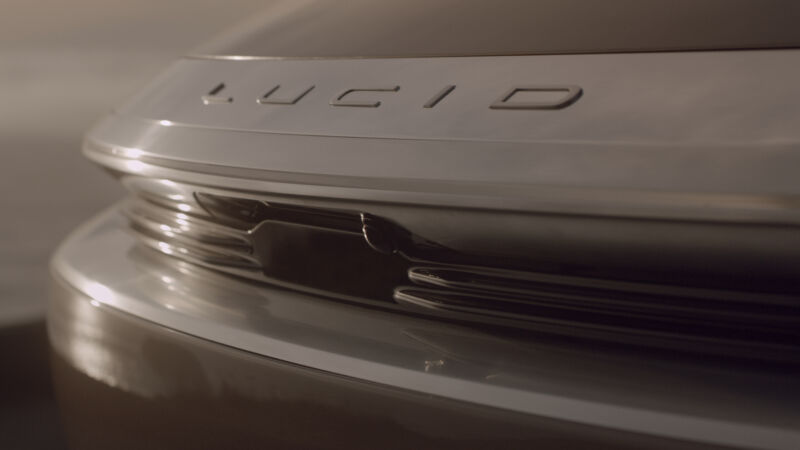
Electric car startup Lucid doesn't like the phrase "Tesla killer," but the comparison is hard to avoid. The company raised $1 billion from Saudi Arabia two years ago and is working on the Lucid Air, a high-end battery electric sedan reminiscent of Tesla's Model S. Lucid is scheduled to officially unveil the car in September and begin selling it next year.
One area where Lucid is looking to differentiate itself from its more established electric rival is with its advanced driver-assistance system (ADAS) called DreamDrive. Elon Musk has ambitious goals for Tesla's Autopilot technology, but the company has struggled to meet them. One possible factor: Musk has ruled out using lidar, a sensor that is widely used by companies attempting to develop fully driverless vehicles.
"Anyone relying on lidar is doomed," Musk said at an event last year to showcase Tesla's progress in self-driving technology. Musk believes that cameras and radar will be sufficient to achieve full autonomy and that lidar is a "crutch" that distracts companies from pursuing more fundamental breakthroughs.
Lucid doesn't agree. This week, the firm announced that its first vehicle would feature a long-range, high-resolution lidar sensor. The company hopes it will help make DreamDrive an industry leader.
How lidar could help DreamDrive leapfrog Autopilot

When Lucid launches the Air next year, it will feature adaptive cruise control and lane-centering capabilities that Autopilot has had for several years. At first, the Air won't have some of Autopilot's more advanced features, such as automatic lane changes.
But DreamDrive could be superior to Autopilot in other ways. The Air will have a driver-facing camera. When driver assistance is active, the car will monitor the driver's eyes to make sure they are focused on the road. If the driver looks away for too long, the car will issue a warning.
Eugene Lee, Lucid's ADAS chief (and no relation to the author), compares this feature to GM's Super Cruise, widely regarded as an industry-leading ADAS.
Lucid also has five radars that provide 360-degree coverage. That should make Lucid's cross-traffic alert feature more powerful. Tesla cars have only a single forward-facing radar.
And Lucid's lidar could help DreamDrive leapfrog Autopilot on the basic task of not running into stuff. Two Tesla drivers have died after Autopilot didn't slow down for semi trucks crossing the road ahead. A third died when his car crashed into a concrete lane divider. Several other Tesla owners have suffered non-fatal crashes when Autopilot steered them into parked fire trucks or police cars in the travel lane.
To be fair, this problem isn't unique to Tesla. ADAS systems that rely on radar typically ignore stationary objects because radar lacks the resolution to distinguish a stationary car in the travel lane from a car parked next to the road or a metal sign hanging above it. Image detection using cameras depends on machine-learning algorithms that can get confused in unusual situations.
In contrast, lidar is extremely reliable at detecting the location of large, stationary objects like a semi truck or a concrete barrier. Lidar works equally well in all lighting conditions and can detect unusual objects as reliably as common ones. So Lucid may be able to produce an ADAS that crashes into parked cars less often than Autopilot or other ADAS products on the market today.
An ambitious roadmap

Lucid won't be the first automaker to bring a lidar sensor to market—that honor goes to Audi, which shipped a lidar-enabled A7 a couple of years ago. But Audi's lidar was comparatively primitive—it had just four lines of vertical resolution, while Lucid's lidar will have more than 100 lines. Lucid's lidar will have a field of view of 120 degrees horizontally and 25 degrees vertically, giving it a broad view of the road ahead—though not on the sides or back. Lucid says its lidar will have a range of 150 meters for objects with a reflectivity of 10 percent, which puts it roughly on par with lidar units being used for fully self-driving prototypes.
Lucid won't be the only car company selling high-end lidar sensors in the next few years. Volvo announced in May that it would begin shipping high-end lidar from Luminar in 2022.
Cars probably don't need such powerful lidars for basic ADAS functionality, but the sensor could give these companies more headroom. Lucid hopes to enable more sophisticated capabilities via a software update over the next few years.
Automatic lane-changing is slated to be delivered with the first major software upgrade about a year after launch. The Air's 360-degree radar coverage could help DreamDrive do this more safely than rivals like Tesla that only offer forward-facing radar.
The update will also allow drivers to take their hands off the wheel in certain circumstances, relying on eye-tracking technology to ensure the driver's attention stays on the road. A powerful lidar sensor will provide an extra margin of safety here, detecting objects that the cameras and radar might miss.
A year after that, Lucid is aiming to ship an "eyes off, hands off" system that doesn't require active driver monitoring. The vehicle will supposedly be smart enough to detect when it's coming up on a tricky situation and alert the driver to take over. Volvo is working on a similar "eyes off" freeway driving system.
Nervous
I'll be honest: this makes me nervous. If a driver hasn't been paying attention to the road, it takes several seconds for them to get fully oriented. So it's easy to imagine a driver being caught off guard by a sudden emergency.
But I would love to be proven wrong. And building a system like this will certainly be easier on a car with a powerful lidar sensor than that just uses cameras and radar alone.
Lucid also deserves credit for setting realistic expectations for its ADAS technology. For several years, Musk has been claiming that Tesla vehicles would soon have driverless capabilities so sophisticated that customers would be able to earn extra money by sending their Teslas out as driverless taxis. I'm skeptical that today's Tesla vehicles will ever have this capability. Experts have told me that Tesla vehicles lack both the sensors and the redundant control systems required for fully driverless operation to be safe.
Lucid's roadmap seems more realistic. The company is trying to build a great ADAS system, but it's not claiming that cars customers buy next year will be capable of fully driverless operation a few years later.
"electric" - Google News
August 01, 2020 at 09:00PM
https://ift.tt/2EH3p4T
Electric car startup Lucid is challenging Tesla’s anti-lidar stance - Ars Technica
"electric" - Google News
https://ift.tt/2yk35WT
https://ift.tt/3bbj3jq


